




The Shift in Conference Marketing Strategy
Traditional conference marketing strategy relies on the organizer broadcasting messages through paid ads, email campaigns, and social media posts from a single company page. This approach is expensive, has declining effectiveness, and competes with millions of other branded messages for attention.
The most effective modern conference marketing strategy flips this model: instead of one channel broadcasting to many, many individuals each broadcast to their unique networks.
When 100 attendees share branded graphics on LinkedIn, they collectively generate approximately 250,000 impressions at zero cost, with personal trust that no advertisement can replicate.
With Go Spread, we just built the easiest way to generate a page to download these graphics. No Canva, no broken cropping tools, no overpriced fotobox platfomrs.
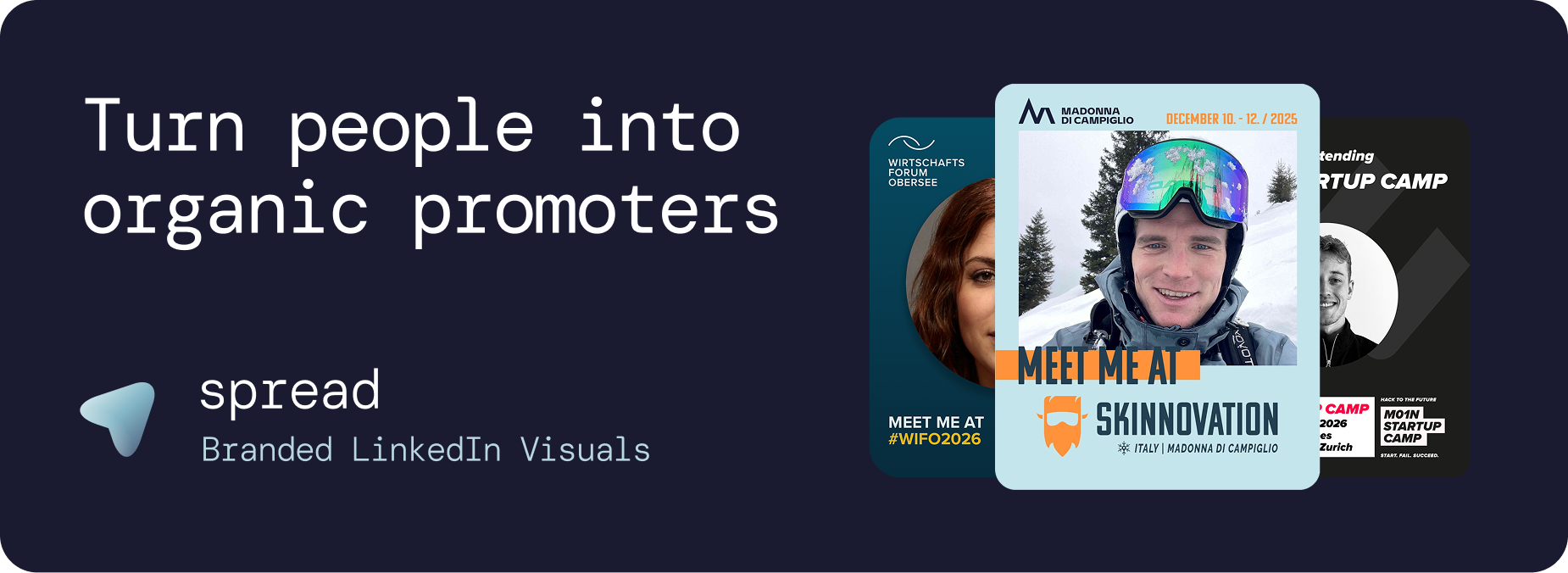
This is not an add-on to your conference marketing strategy. This is the highest-ROI tactic in your conference marketing strategy.
Why Attendee Advocacy Is the Core of Modern Conference Marketing Strategy
1. Trust Advantage in Conference Marketing Strategy
A colleague sharing "I'm attending [Conference]" carries infinitely more weight than a sponsored post. This trust advantage is the foundation of an attendee-centered conference marketing strategy. People make attendance decisions based on peer behavior, not advertising.
2. Algorithmic Advantage in Conference Marketing Strategy
LinkedIn gives personal content 3 to 5 times more distribution than company page content. An attendee-centered conference marketing strategy automatically benefits from this algorithmic preference, dramatically extending reach.
3. Cost Advantage in Conference Marketing Strategy
Once set up (under 10 minutes with Go Spread), every additional share in your conference marketing strategy is free. There is no budget cap, no cost per impression, no diminishing returns. This makes attendee advocacy the most cost-effective element of any conference marketing strategy.
4. Scale Advantage in Conference Marketing Strategy
Each attendee reaches a unique professional network. A conference marketing strategy built on attendee advocacy scales exponentially: 200 attendees reach 200 distinct networks, creating visibility that no single channel can match.
Your Conference Marketing Strategy: The Complete Timeline
12 Weeks Before: Planning Your Conference Marketing Strategy
Define visual identity for attendee graphics
Create branded templates with Go Spread
Write pre-written LinkedIn captions for each role variant
Plan distribution touchpoints
4 Weeks Before: Speaker Activation
Launch speaker graphics as the first phase of your conference marketing strategy. Speakers have larger networks (usually 5,000 to 30,000, or more, connections) and higher authority. Their shares are the highest-impact early promotions in your conference marketing strategy.
3 Weeks Before: Attendee Launch
The core of your conference marketing strategy. Include the graphic creation link in registration confirmation emails, event website, and social media. This is when the majority of attendee shares happen.
2 Weeks Before: Sponsor Activation
Provide sponsors with co-branded templates as part of your conference marketing strategy. This gives sponsors measurable LinkedIn exposure and a tangible sponsorship deliverable.
1 Week Before: Reminder Wave to everyone. Main Event. Most Traffic.
Send a follow-up to registered attendees who have not yet created their graphic. Many intend to participate but forget. This reminder wave captures significant additional shares in your conference marketing strategy.
During Conference: Live Sharing
On-site photo graphics create real-time sharing that generates FOMO and interest in future editions. This live element of your conference marketing strategy captures attendees who missed pre-event communications.
1 Week After: Post-Event Extension
"I was at [Conference]" or "Thank you [Conference]" graphics extend your conference marketing strategy lifecycle. Attendees share key takeaways alongside branded visuals.
Conference Marketing Strategy: Channel Integration
1. Email Integration
Your conference marketing strategy should include the graphic creation link in:
Registration confirmation (highest conversion)
Dedicated "Create Your Graphic" email
Pre-event newsletter mentions
Speaker welcome emails with speaker templates
Sponsor activation emails with sponsor templates
2. Website Integration
Your conference marketing strategy should feature the graphic creation prominently on the event website:
CTA button on the homepage
Dedicated page with example graphics
Post-registration redirect to graphic creation
3. Social Media Integration
Your conference marketing strategy should use social media to showcase early adopters:
Share example graphics from the event account
Repost attendee graphics to build social proof
Create countdown posts featuring attendee graphics
Go Spread: The Platform for Your Conference Marketing Strategy
Go Spread powers the attendee advocacy element of conference marketing strategy for leading events including Skinnovation, WIFO, SICTIC Forum, Entra, the Operator Circle, ChefTreff, and Global Talent Summit.
Conference Marketing Strategy Features
Visual template builder: Create branded templates in minutes
Auto branding: Extract logo and colors from your conference website
Brand-locked templates: Every graphic stays on-brand
Role badges: Attendee, Speaker, Sponsor, VIP, Mentor, custom
Pre-written captions: One-click copy LinkedIn captions
No account needed: Zero friction for attendees
Mobile-first: Optimized for smartphones
Analytics: Track your conference marketing strategy performance
LinkedIn direct posting: Share directly to LinkedIn
Conference Marketing Strategy: Measuring Success
Metric | What It Measures | Benchmark |
|---|---|---|
Download rate | % of attendees creating graphics | 15-30% |
Conversion rate | % of page visitors who download | 60-80% |
Estimated impressions | LinkedIn reach from shares | 2,500 per share |
Template performance | Which designs resonate most | Varies |
Daily trends | When sharing peaks | Launch day + reminders |
Conference Marketing Strategy: Common Pitfalls
Pitfall 1: Treating Attendee Graphics as an Afterthought
In the most effective conference marketing strategy, attendee graphics are a primary channel, not a "nice-to-have." Allocate the same strategic attention as you would to paid campaigns.
Pitfall 2: Launching Too Late
A conference marketing strategy that launches attendee graphics 3 days before the event creates a brief spike instead of sustained momentum. Launch 4 weeks before.
Pitfall 3: No Captions
A conference marketing strategy without pre-written captions leaves shares on the table. Captions increase share rates by 3 to 5 times.
Pitfall 4: Single Template
A conference marketing strategy with only one generic template misses the power of role differentiation. Create separate templates for speakers, sponsors, and VIPs.
Get Started with Your Conference Marketing Strategy
Build your conference marketing strategy with attendee advocacy at go-spread.com. Free tier available, setup under 10 minutes.
Contact Go Spread for enterprise conference marketing strategy solutions.