



To increase event registrations, fix the offer and the sign-up page first, then add channels that reach people who already trust someone attending: speakers, sponsors and the attendees you've already got. Below are 15 tactics, roughly in the order we'd try them, with organic attendee sharing as one of the cheapest.
None of these is magic on its own. But stacked together, and started early enough, they're the difference between a sold-out room and a frantic discount email ten days before doors open.
Start with the offer before you try to increase event registrations
More promotion won't fix an event people don't understand. If your page can't explain in one sentence who should come and what they'll leave with, every channel you add will convert poorly, and you'll blame the channel.
So before you spend a euro on promotion, read your registration page as a stranger would. If you can't increase event registrations from the people who already land there, more traffic just means more people leaving.
1. Write a one-line promise for one specific person
"The fintech summit for Europe" is a category. "Two days for heads of payments at European banks, with 40 pre-booked 1:1 meetings" is a reason to register. Write the version for your most valuable attendee and put it at the top of the page, above the agenda and above the sponsor logos.
2. Cut the event registration form down to what you'll use
Every extra field loses someone. Ask for name, email, company and role, plus at most one question you'll actually act on (dietary needs can wait until the confirmation email). If you need more data for matching or badges, collect it after the ticket is secured, when people are already committed.
3. Show proof that real people are coming
A list of confirmed speakers with photos, a handful of named companies attending (with permission), a quote from last year. People register for rooms they can picture, and a page with nothing but a date and a venue gives them nothing to picture. If it's your first edition, use your speakers and partners as the proof, since that's what a first-time attendee is really buying into.
Event registration strategies built on pricing and deadlines
Deadlines move people. A price change or a cutoff gives someone a reason to decide today instead of next week, so the job is to create several honest ones across your campaign.
4. Early bird pricing boosts event registrations only if the deadline holds
An early bird that gets extended twice teaches your audience to wait. Pick a date, announce it three times (two weeks out, three days out, the morning of), and then let it expire. You'll lose a few late deciders at the cheap price, and that's fine, because next year more of them will move on time.
5. Offer a group or bring-a-colleague rate
One registration that brings a second is the cheapest attendee you'll ever get. A simple "second ticket at 50%" or a team bundle for three works well for B2B events, where the person registering often has a colleague who'd benefit just as much and a manager who'd rather approve one invoice. Make the second seat easy to add in the same checkout, because asking someone to come back later for a colleague's ticket is asking a lot.
6. Be honest about capacity
If a workshop has 30 seats, say so, and show when it's nearly full. Scarcity only works when it's real. Fake countdown timers get noticed, and they cost you trust with exactly the senior people you want in the room.
How speakers and sponsors help you sell out events
Speakers and sponsors already have the audience you want. Say one of your speakers has 8,000 LinkedIn followers in your target industry: her post lands in feeds your company page never reaches, and it comes from a person her network actually knows.
7. Give every speaker a ready-made graphic and caption
Speakers will happily post if you remove the work. Send each one a branded speaker graphic with their photo and session title, plus a suggested caption they can edit, and ask them to post on a specific day. Our guide to speaker visuals for events covers what to include.
8. Turn sponsors and exhibitors into promoters
Sponsors want visibility and booth traffic, so ask them to invite their own customers. A Partner or Visit Us graphic with the sponsor's logo next to yours, sent two or three weeks before the event, gives their marketing team a post they can schedule without a design request. There's more on that in our piece on sponsor activation at events.
Attendee sharing: the cheapest way to increase event registrations
Your registered attendees are your best salespeople, because their colleagues trust them more than they trust you. In a Nielsen global study reported in 2014, 92% of consumers said they trust recommendations from people they know completely or somewhat.
9. Put a share link in the registration confirmation email
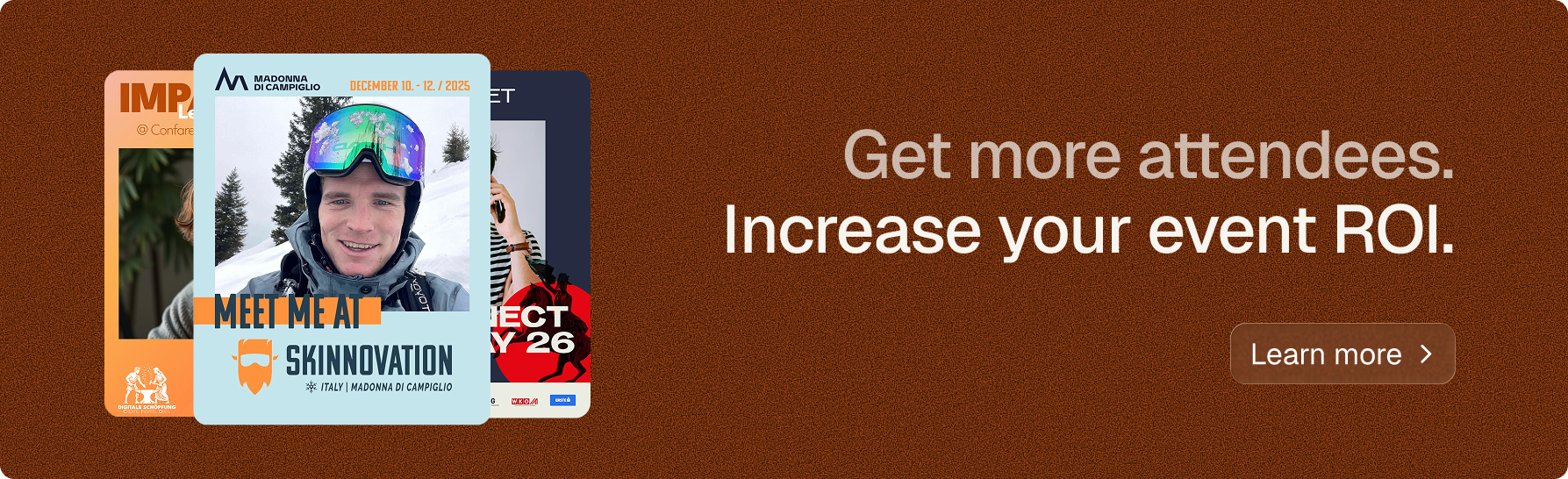
Someone who just bought a ticket is at peak excitement. That's the moment to offer them a personalized "I'm attending" graphic, with their photo and your branding, that they can post on LinkedIn in under a minute. Go Spread works this way: you design one template, share one link (or embed a pop-up on your confirmation page), and every attendee gets their own graphic and a suggested caption, without an account.
The numbers add up quickly. Across the first 20 Go Spread campaigns, the average was about 100 attendee posts and around 250,000 impressions per event, and at M01N Startup Camp the organizers put it this way: "Our attendees turned LinkedIn red in just 1.5 weeks."
10. Send one share reminder before the event
Plenty of people mean to post and forget. A short reminder about five days before the event, ideally mid-week, catches the ones who didn't share at registration and are now starting to plan their trip. Keep it to two lines and the link. If you use Go Spread, the analytics show views, downloads and LinkedIn impressions, so you can see whether the reminder produced a second wave of posts before you decide to send another.
Email and LinkedIn tactics to boost event registrations
Owned channels still do a lot of the heavy lifting, if you segment them. A single blast to your whole list is easy, and it's also the version that gets ignored.
11. Invite past attendees first to boost event registrations early
People who came before are your warmest audience. Give them early access or a returning-attendee price a week before public launch, and send it from a person's name. For more ways to reward early sign-ups, see our guide on pre-event marketing for early registrants.
12. Write emails around one reason each
Each email in your sequence should carry one new reason to register: a speaker reveal, a workshop opening, the agenda going live, the early bird closing. Mixing all four into one long newsletter dilutes every one of them. Six short emails over six weeks, each with a single link, are easier to read (and easier to measure) than three long ones.
13. Post on LinkedIn from people, with the event page as backup
A LinkedIn Event page is useful for reminders and RSVPs, although most of the reach comes from personal profiles. Have your team, your speakers and your sponsors post, and link to the event page or registration page from those posts. Our organic LinkedIn playbook walks through the weekly plan.
Measure which event registration strategies work
You can't double down on what works if you don't know what works. Two habits cover most of it:
- A UTM-tagged link for each channel, so speaker posts, sponsor posts, attendee posts and emails show up separately in your analytics.
- A required "How did you hear about us?" field with five or six options, which catches the word-of-mouth registrations that tracking links miss.
14. Track event registrations by channel every week
Check the numbers every Monday and move effort toward what's working. If speaker posts drive three times more registrations than paid social, the next speaker reveal deserves more attention than the next ad set.
15. Ask the last 50 registrants what tipped them
A one-question email ("What made you register this week?") gets surprisingly honest answers. You might hear about a colleague's post, a specific speaker or the early bird deadline, which tells you exactly where to push in the final stretch. And keep those answers, since knowing what tipped people this year is how you increase event registrations faster next year.
Increase event registrations with one change this week
If you only try one thing to increase event registrations, make it the share link in your confirmation email, because it costs nothing and keeps working while you focus on everything else. These are the moments where it pays off most:
- Right after purchase, when excitement is highest.
- A few days before the event, as a reminder for the people who meant to post.
- On the day itself, for attendees who want to show they're in the room.
Set up a free campaign on Go Spread, add the link to your confirmation email today, and check next Monday how many registrations came in from attendee posts.