




Best Event Networking Apps in Comparison: 8 Mobile Apps for Matchmaking
Best event app for networking platforms compared. Ask a founder what they brought home from a conference, and they will rarely mention a keynote. They will mention a person: the investor who sat at the same lunch table, the customer who stopped by for a chat, the operator whose one piece of advice saved them three months of work.
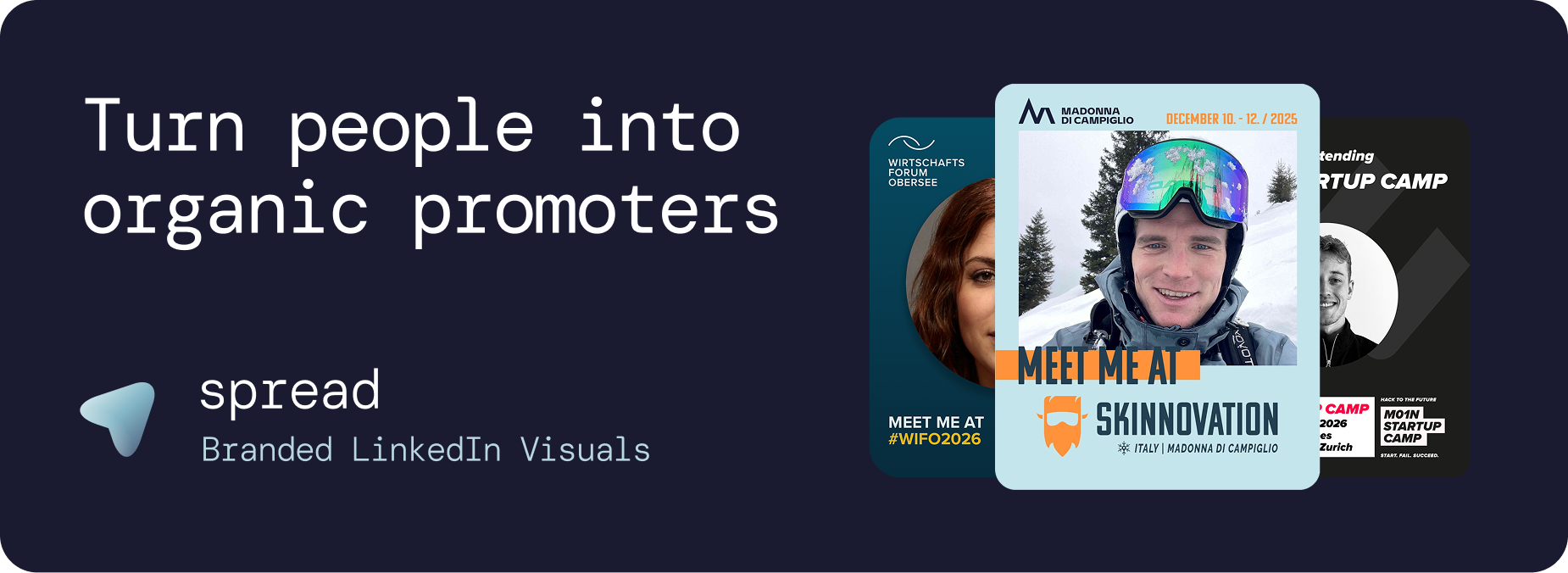
I have been that founder at many events, and today I sit on the other side, as host of Switzerland's third largest startup conference and as founder of Go Spread, a tool that helps organizers fill their events through LinkedIn. Both roles taught me the same lesson, namely that an event is only as good as the conversations it creates, and that the app you hand to your guests decides, more than most organizers like to admit, whether those conversations take place or never get started.
The trouble is that the market is crowded. Every website promises smart networking, and the details that really matter, such as how you pay, how long setup takes and whether guests have to install anything, often hide behind a button that says "request a demo".
So I placed eight platforms next to each other and looked at them the way I would if I had to choose one for my own event next week. There is no ranking in this article, because a founder dinner for 200 guests and a trade show with hundreds of exhibitors need very different tools, but there is a clear look at what each platform does well, what it costs when the price is public, and what you should ask before you sign.
All product facts come from the vendors' own websites, or my personal experience at events. When a company keeps something private, like a price or a hosting region, I point that out rather than fill the gap with an estimate.
The features the best event networking app needs
Before any demo, each tool has to answer the same seven questions. If an app fails two or three of them, I usually stop there, however good the slides look.
Can I launch it on my own?
Event teams are small, and in the weeks before an event they deal with speakers, sponsors and catering, not with project calls. A good app lets you create the event, add your branding and invite your guests yourself, while support stays there for the moments when you actually need it.
Is the price fair for the way I run events?
Plenty of tools in this space charge enterprise prices to organizers who run one or two editions a year. What I look for is a price on the website, a model that fits my rhythm (per event or per year), and no extra charge each time a new guest signs up.
Can guests see who else is coming?
Profiles are the base of everything else. Guests should see names, roles, companies and what each person hopes to get out of the day, and they should be able to filter by it, since without that context nobody knows where to begin.
Does it suggest whom to meet?
Here is where AI matchmaking earns its place, because the app reads profiles and goals and moves the most relevant people to the top, so that a guest who opens it between two sessions gets three or four strong suggestions rather than a long scroll. Some platforms let the organizer set fixed rules instead, which is a fair choice too, as long as the outcome is a short and sorted list.
Can two people fix a meeting quickly?
A match is worth little if the meeting never gets a time and a place. I want a planner where one person proposes a slot, the other confirms, both see it in their personal schedule, and the app flags any overlap with a session.
Is the program always current?
Guests open the agenda more than any other screen. Changes to rooms or times should reach everyone at once, people should be able to save the sessions they care about, and the agenda should be aware of their meetings.
Is there room to sell to sponsors?
Sponsors are what keeps ticket prices low, so the app should give them something real: visible placements, stories, messages to the audience, or a way to book meetings with the right guests. Once that works, the app pays back part of its own cost.
Best 8 Event Networking app compared side by side
Two vendors put a real price on their website, three let guests start in the browser, and the other five send people to an app store before the networking can begin.
Platform | Price on the website | Contract style | Getting started | How matching works | Booking meetings | What sponsors get | Join without installing |
|---|---|---|---|---|---|---|---|
Yes, from 89 EUR per event | Per event or yearly | Organizer sets it up alone, demo optional | AI score from role, goals and interests | Slot proposals, clash check, personal plan | Placements, stories, broadcasts | Yes, PWA on home screen | |
Plan tiers shown, prices on request | Yearly | Trial on Starter, demo for larger plans | AI recommendations, meeting builder as add-on | Request rules by organizer, hosted buyer as add-on | Ads and lead tools, mostly add-ons | No, store app | |
No | On request | Sales call or demo | AI based on what each guest wants | Few clicks, AI picks a free spot | Own dashboard, meeting requests before the event | No, store app | |
No | On request | Through sales | Directory and chat, no matching engine promoted | Messages and meet-ups | Not stated in detail | No, store app (free for guests) | |
Entry plan: 699 EUR per year for 100 guests | Yearly, larger plans on request | Through sales | Machine learning on stated goals | B2B meeting planner | Marketplace | Web app available | |
No | Per user, on request | Through sales, online product tour | Smart matching plus Klik badges | Meetings inside the app | Lead capture via Klik | No, store app | |
No | On request | Through sales | Rules set by the organizer, no AI | Fixed schedules with table and room | Not stated | Web app available | |
No | Sold within the Cvent suite | Through sales | AI from profile and behaviour | Messages and appointments | Not stated in detail | No, store app with login |
Source: each vendor's own website (Sep. 26). Add-ons and plan limits change often, so check the vendor's pricing page before you commit.
Best Mobile Event App Comparison
For every tool you will find what it does, where it is strong, and the one question I would bring to the first call.
Conferras
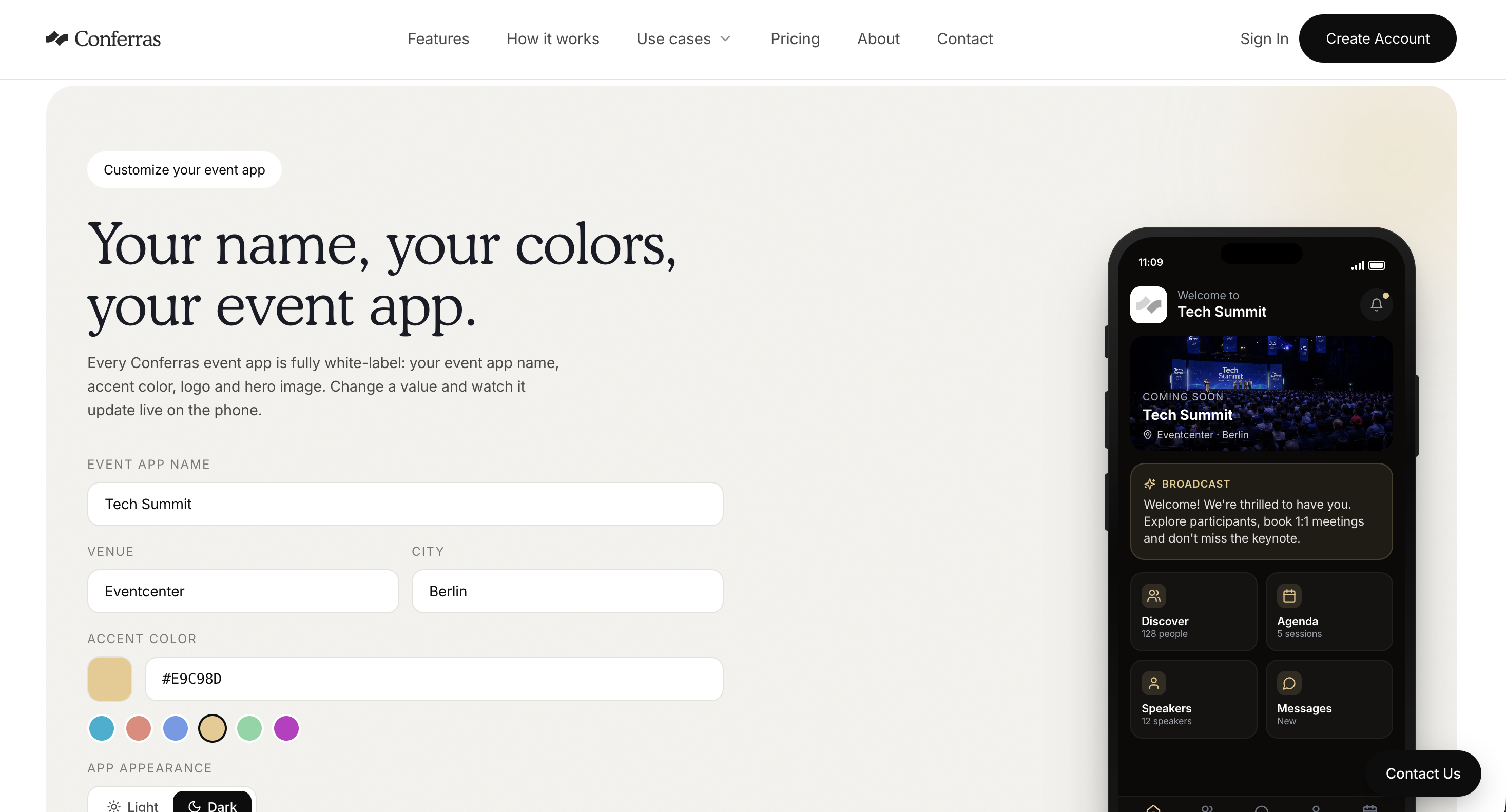
Conferras is by far the most affordable event app in this comparison, starting at 89€ per event, instead of several thousand Euros. Prices are transparent and listed on the website. It matches all features required for this comparison and is perfect for events from 100 to 15.000 people. Conferras is a great alternative to apps like Whova, Cvent, and Brella.
Conferras focuses on a single job, the networking layer of an event, and leaves badges and onsite hardware to the tools an organizer already uses. That focus shows in how guests get in: they receive a private link or a QR code, the app opens in the browser as a progressive web app, and anyone who wants it on the home screen can put it there and still get push notifications on iPhone and Android.
For organizers, setup runs through a three-step wizard, and since the event carries your own logo, accent color, app icon and subdomain, guests never see the vendor's brand. Inside you will find profiles with a directory, AI scoring that matches people on role, goals and interests, private messages, a meeting planner that proposes slots and checks for clashes, agenda and speakers, stories, sponsor placements and organizer broadcasts backed by live numbers. Hosting sits in the EU and follows GDPR.
Strong at: most affordable, fast self-setup, access through the browser, open per-event pricing.
Ask about: how guests from your ticketing tool receive their invite link, since tickets are not part of the product.
Conferras, Website
Swapcard
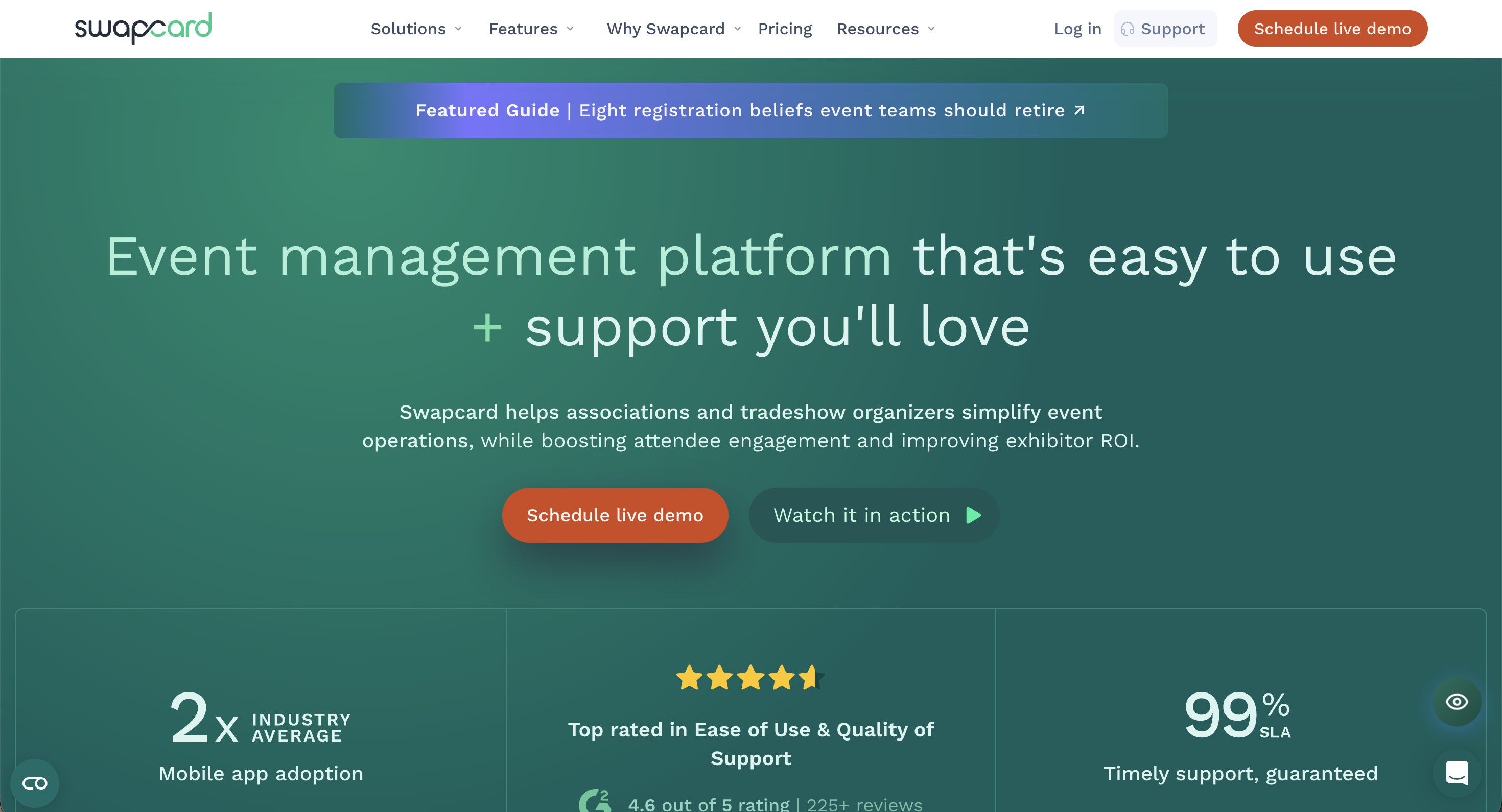
Swapcard covers the full life of an event, from registration to exhibitors, and it is one of the few vendors that shows how its plans are built, even though the actual numbers only come on request. There are three levels, Starter for up to 1,000 guests a year, Professional for up to 10,000 and Enterprise with no cap, and all of them are yearly subscriptions, because Swapcard does not offer monthly or per-event billing.
The AI list is long, with recommendations, event AI agents, an assistant named Sherlock, suggested leads for exhibitors and a tool that creates meetings automatically. Several of the features that matter most for networking, though, such as hosted buyer meetings, that automatic meeting tool, advanced banner ads and lead qualification, are paid extras that the Starter plan cannot add, and a fully white-labelled app is a separate purchase as well.
Its security papers are extensive, covering ISO 27001, SOC 2 Type II and PCI DSS v4.0, with hosting on AWS across several zones and no region named.
Strong at: large programmes that run all year with many exhibitors.
Ask about: the total price once every add-on you need is included.
Swapcard, Website
Brella
Brella sells a package for in-person events that combines matchmaking, ticketing and a native app for iOS and Android which can carry your brand. Guests tell the app what they want to achieve, and Brella says its algorithm turns that into matches within seconds.
The meeting flow is pleasantly short. One person proposes a time, the other confirms or moves it, and the platform picks an open meeting location by itself, so nobody wanders through the venue looking for their contact. Sponsors are well looked after, because they can search attendees for promising leads, ask for meetings before the event and later see booth visits and meeting counts in their own dashboard, which hands the organizer real numbers for the renewal talk.
GDPR is covered in a data processing agreement, and Brella says its host holds ISO 27001, without naming a region. Prices come through sales.
Strong at: sponsor reporting and smooth meeting booking.
Ask about: the cost for your event size, and how many guests usually install the app.
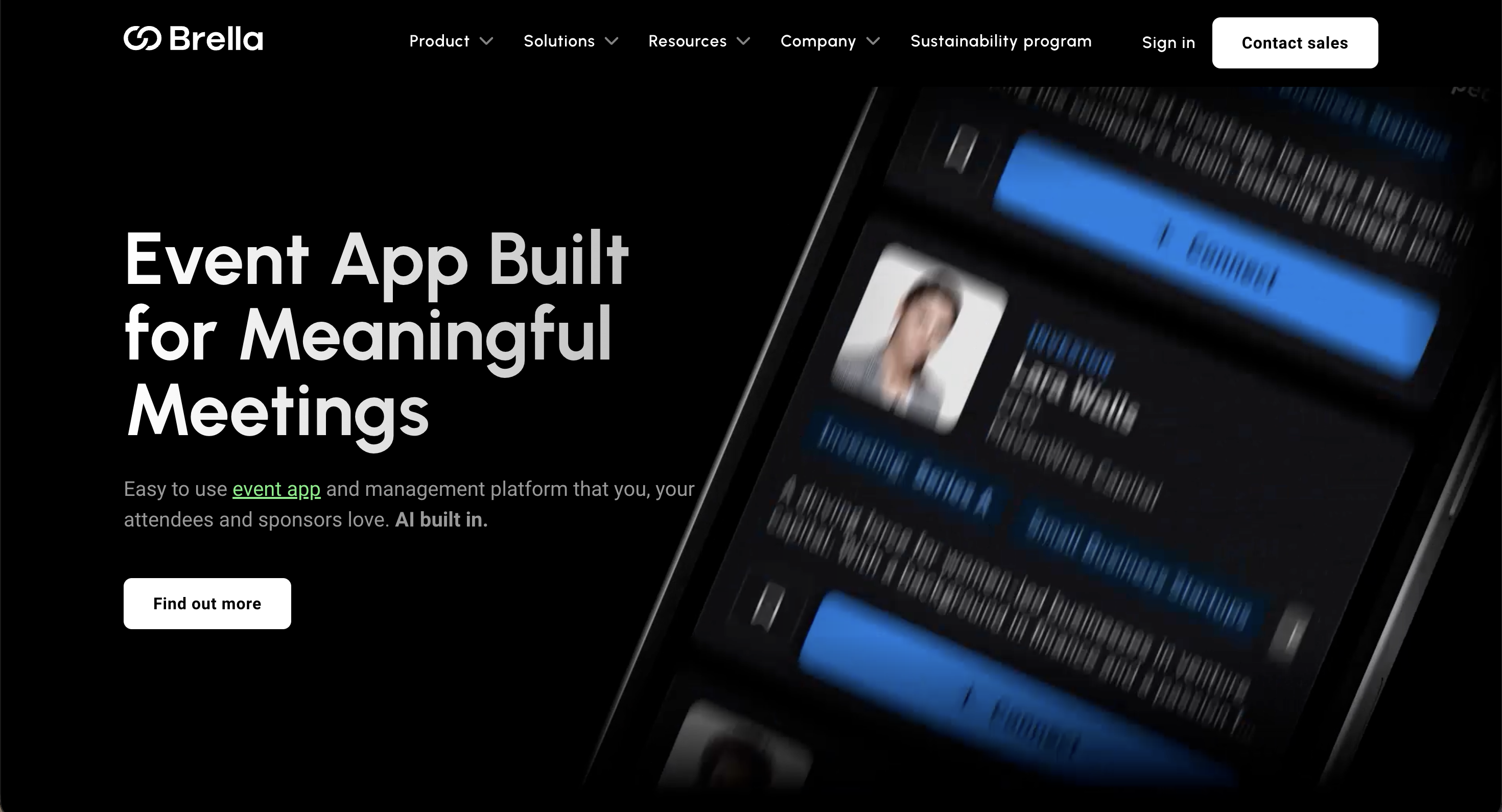
Brella, Website
Whova
Whova puts engagement first. Next to the app it offers online registration, marketing tools and organizer features, while guests get a personal schedule, reminders before sessions, live polls and Q&A, gamification, a business card scanner and a community board that comes to life days before the event.
Users often praise its agenda, and since the app costs guests nothing, many of them install it. Networking is more open than structured, which means you search the directory and send messages, yet Whova does not promote a dedicated matching engine, and that matters if you have promised exhibitors a certain number of meetings.
The company is based in the US and works under the EU-U.S. Data Privacy Framework. There is no public price, and figures you may see on other websites are estimates by third parties.
Strong at: community feeling, agenda, interaction during sessions.
Ask about: how meetings between guests get planned, if that is a key promise of your event.
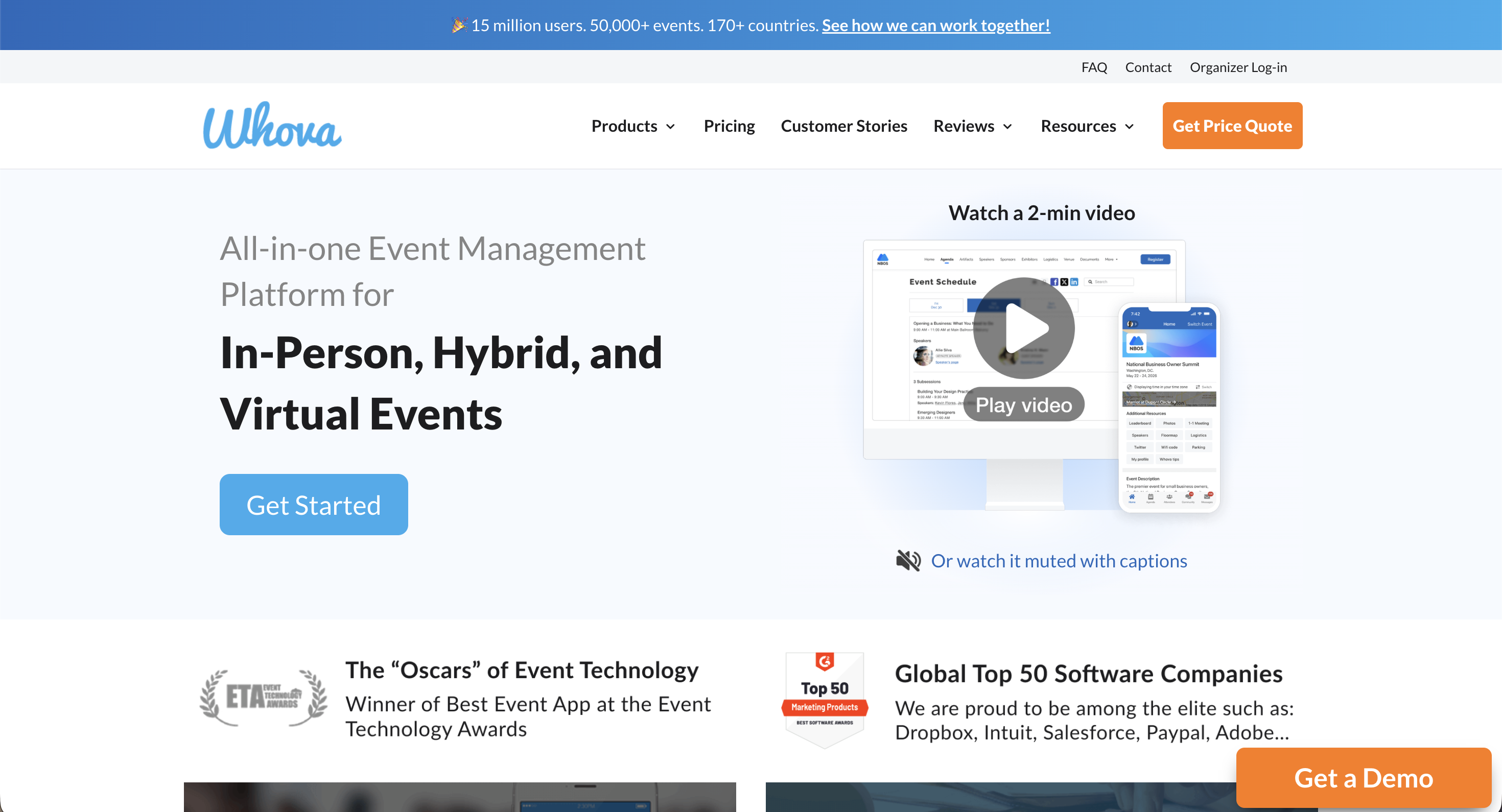
Whova, Website
b2match
b2match comes from the world of B2B matchmaking, and its logic reflects that: every participant sets goals, and machine learning proposes profiles that fit them. That is why you meet the tool so often at brokerage events, cluster meetings and trade missions.
It also builds a multi-page event website, handles registration and ticketing, shows an agenda and runs a marketplace, so it reaches deeper into event organization than a pure networking tool. Guests normally sign up through that event website.
What sets b2match apart is how clearly it speaks about data, since all event data stays within the EU on Google Cloud Platform, backed by ISO/IEC 27001:2022. An entry plan is listed at 699 EUR per year for 100 attendees, and anything larger is priced on request.
Strong at: EU-only hosting and goal-based B2B meetings.
Ask about: what the price looks like once you pass 100 guests.
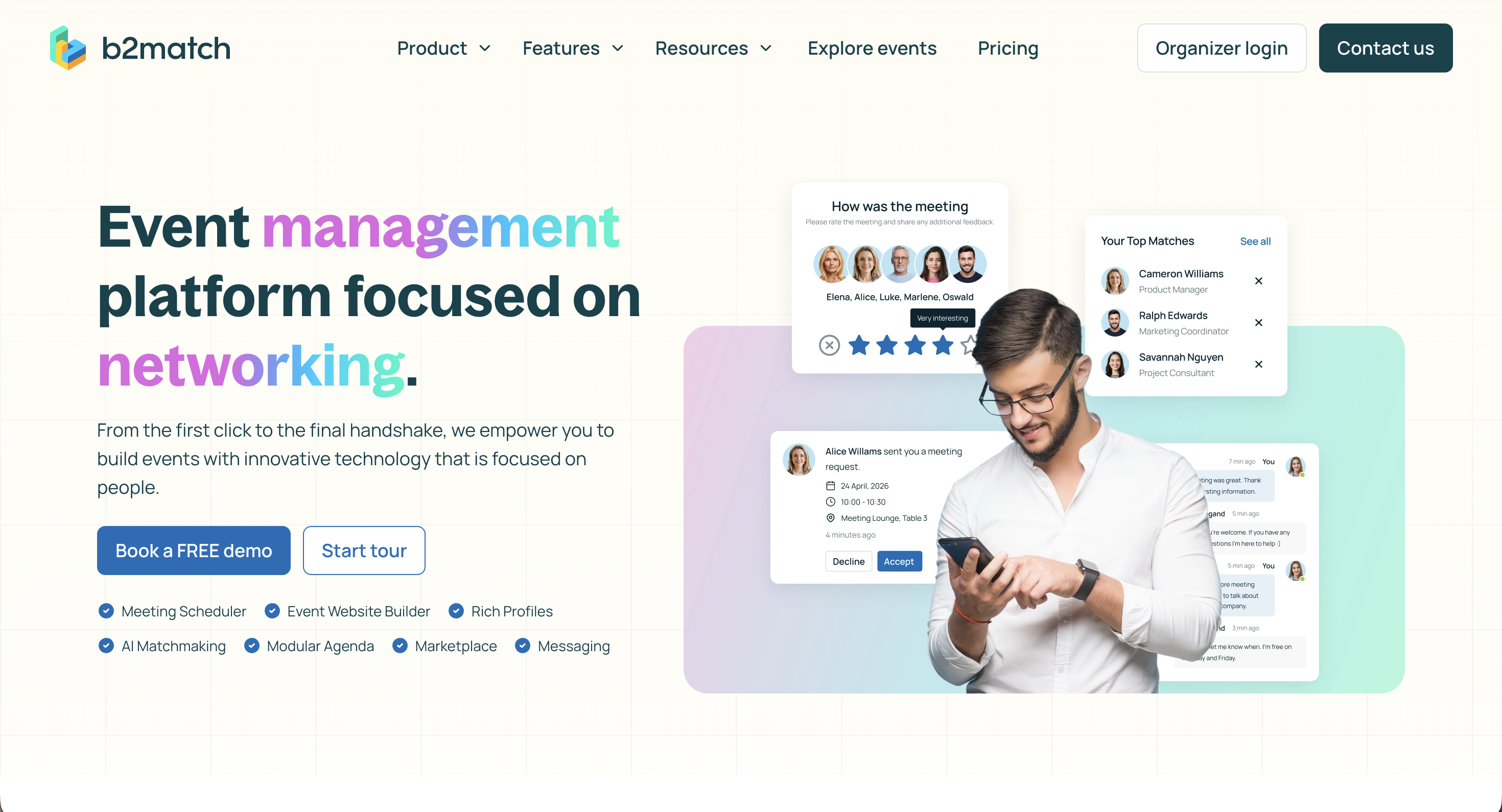
b2match, Website
Bizzabo
Bizzabo targets B2B conference programmes and bundles code-free websites, registration, tickets, agenda, streaming, marketing and reports into one system. For networking it pairs software matching with a physical device, the Klik SmartBadge, which guests wear to swap contact details with a tap and which exhibitors use to capture leads without a scanner.
The attendee app runs under your brand, and guests can log in at the very moment they receive their badge at check-in, a well-chosen point in time, because nobody is more open to trying something new than a person who has just walked through the door. Bizzabo states GDPR compliance, follows the EU-U.S. Data Privacy Framework and offers SSO, but does not say where data is hosted.
Pricing is on request, and Bizzabo describes the model as per user, with no limit on registrations or events.
Strong at: large B2B conferences that want hardware for contact exchange.
Ask about: what you pay for if networking is the only part you need.
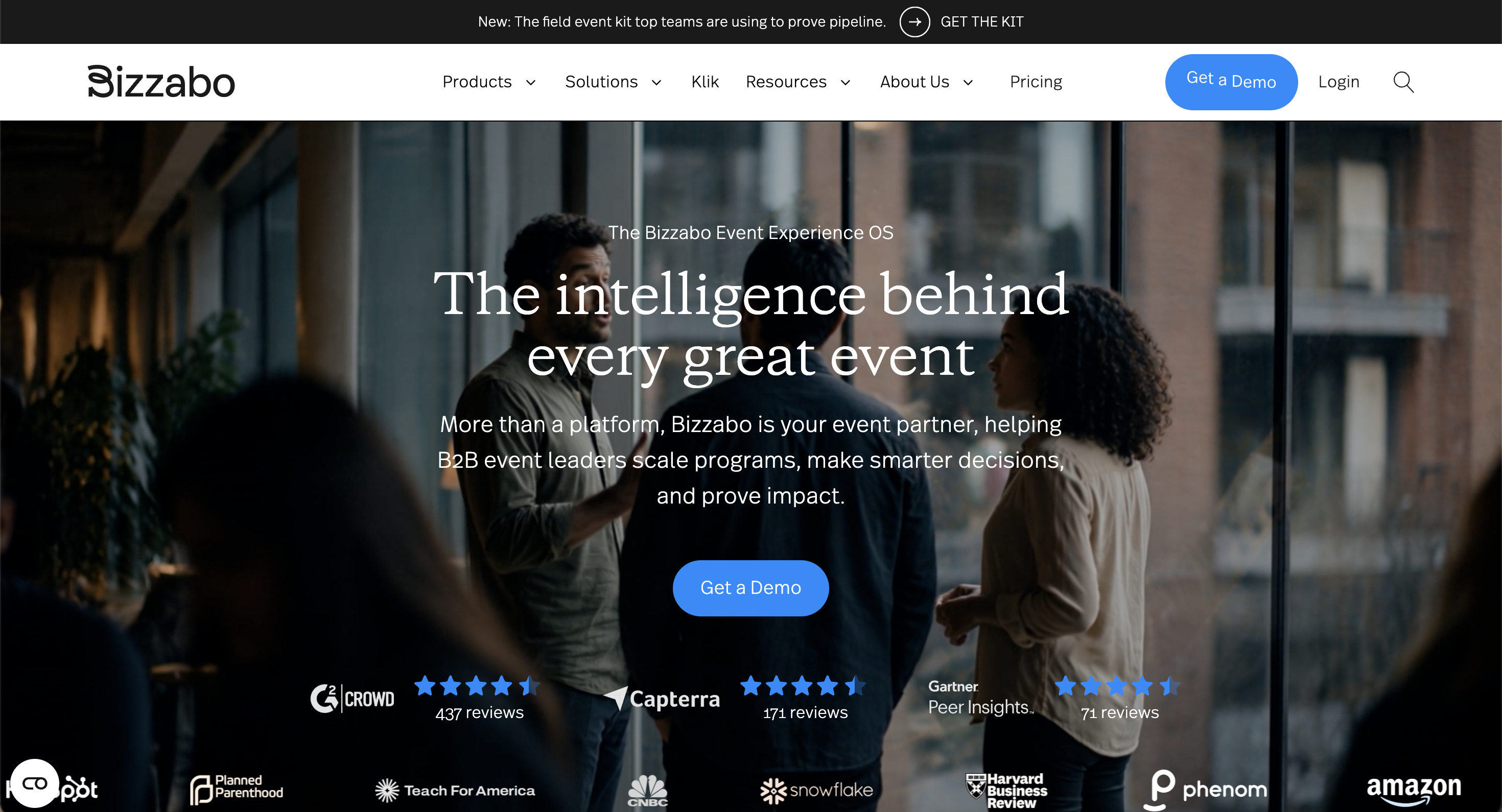
Bizzabo, Website
Converve
Converve takes a different path from the rest of this list. The organizer builds a matrix that defines which groups may meet, which may see each other and which stay hidden, so that buyers meet suppliers and not their rivals, and Converve presents this openly as an alternative to AI-driven matching.
Based on those rules it creates 1:1 schedules without overlaps and assigns tables and rooms, which helps a lot when hundreds of short meetings run at the same time. The company dates back to 2000, holds ISO/IEC 27001 certification and highlights German data security.
On its website there is also a calculator that estimates the possible number of meetings from guests, tables, meeting length, breaks and event days, a quick sanity check for any event, whichever tool you end up with. Prices are on request.
Strong at: strict, rule-based buyer and supplier meetings.
Ask about: how much freedom guests have to find people outside the rules.
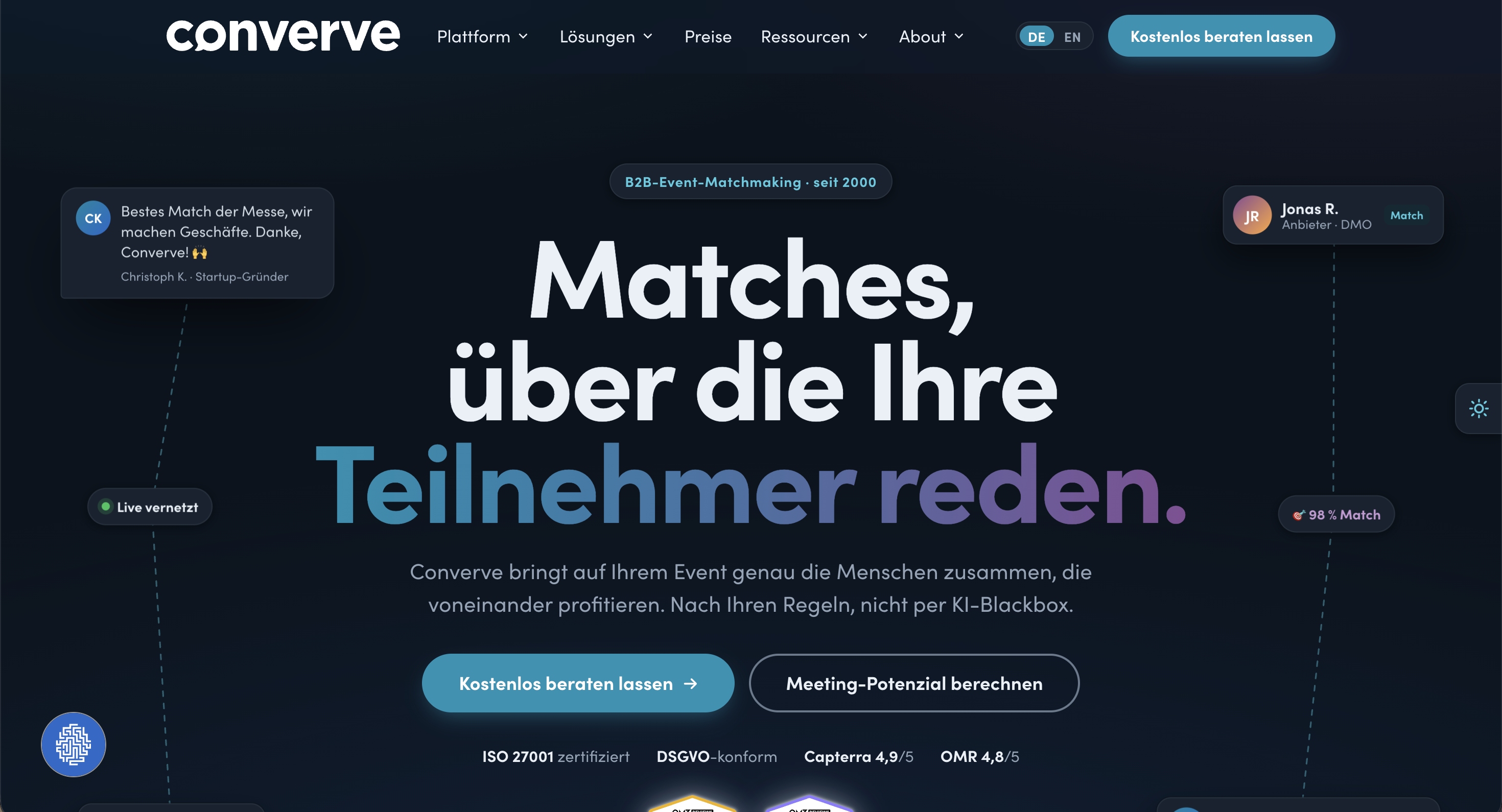
Converve, Website
Cvent Attendee Hub
Attendee Hub is the mobile part of Cvent's large event platform, and its main advantage is integration. If you already handle registration, check-in and badge printing in Cvent, the app draws on the same records, so changes to the program reach guests without anyone moving data around by hand.
Cvent describes AI networking that suggests contacts based on attributes and behaviour, with messaging and 1:1 appointments inside the app, while CventIQ adds session tips and a daily summary. Access is tightly controlled: guests must log in, SSO is available, and events can be set to invite-only or hidden, which helps for internal or regulated gatherings.
For customers in the EU, Cvent names AWS locations in Frankfurt and Dublin. Pricing comes through sales, and the app is sold as part of the broader platform.
Strong at: companies already on Cvent, tight access control.
Ask about: how long onboarding takes and which parts of the suite you have to buy along with the app.
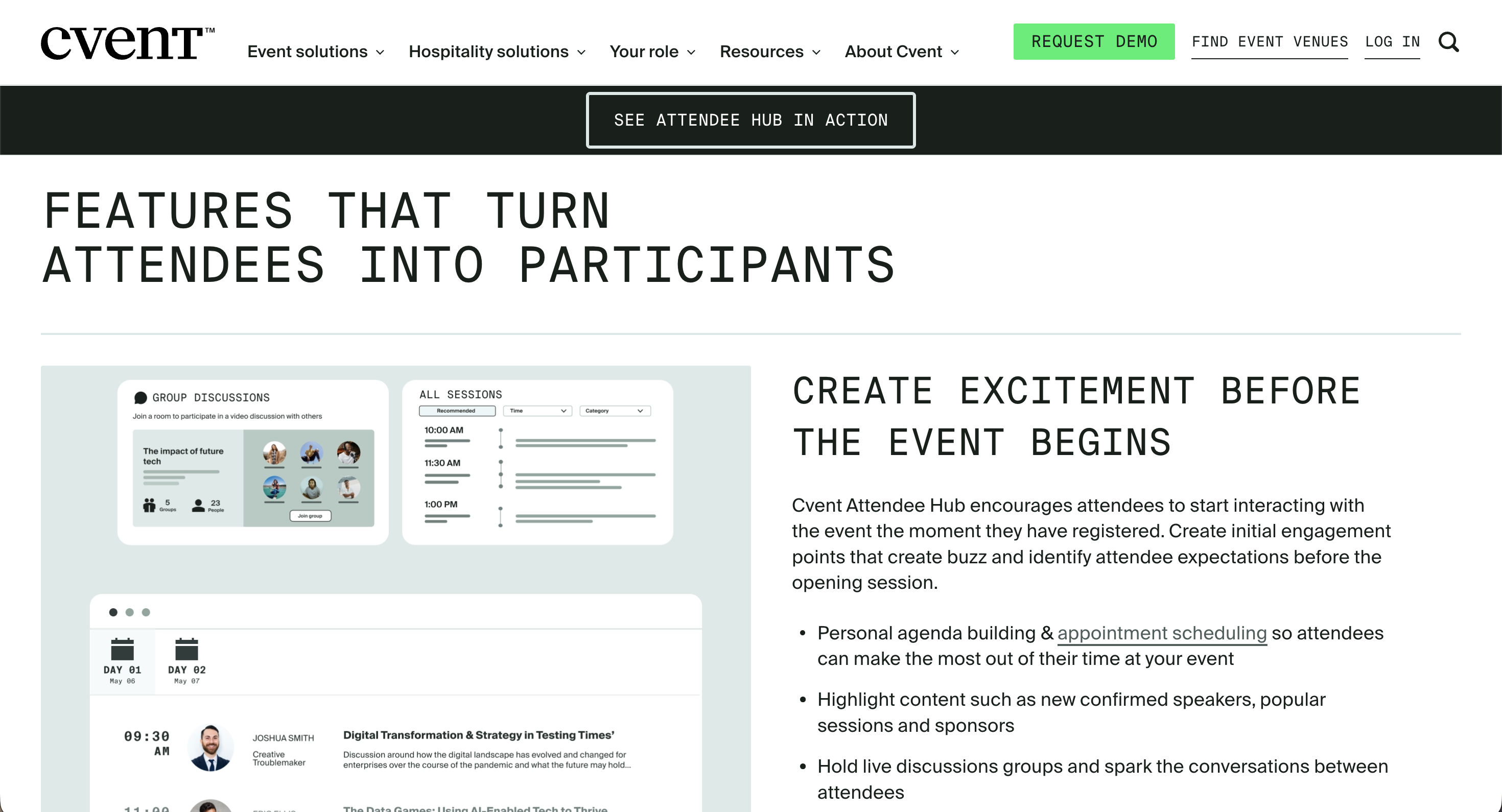
Cvent, Website
Six questions for your mobile event app comparison
Sales demos are polished by design, so I go in with a short list of questions that reveal more than any slide deck could.
What is the total price for my event, including every add-on I would really use?
Is this a yearly contract, or can I pay for a single event?
Can I set up and publish the event without help from your team?
What does a guest have to do, step by step, from the invite to the first confirmed meeting?
Where exactly is our data hosted, and will you confirm that in writing?
What can I offer sponsors inside the app, and what results do they see afterwards?
After the call, I open the guest side on my own phone, exactly as an attendee would after getting the invite, because that first impression says more about adoption than any feature list.
One more point that no app can fix by itself: even the smartest matchmaking falls flat when guests open the app for the first time on the morning of the event.
The weeks before are when people fill in profiles and start reaching out, and that is one of the reasons I started Go Spread, which lets attendees post a personal "Meet me at" graphic on LinkedIn so that the networking begins online, well before the doors open.
